
Picture this: it’s tax season, you open your spreadsheet to tally up a year of crypto trades, and you’re staring at 400+ transactions across three exchanges and two wallets. You bought BTC on Coinbase, swapped into ETH on Uniswap, added liquidity somewhere, got some staking rewards, moved funds around between wallets, and now you need to figure out what you actually owe. Good luck doing that by hand.
That’s the problem crypto tax software solves — and in 2026, it’s more relevant than ever. Centralized exchanges are now issuing Form 1099-DA to the IRS, which sounds like it should simplify things. It doesn’t. Those forms report gross proceeds only, not cost basis, which means the IRS gets a number that looks a lot bigger than your actual gain. You need your own records to correct that picture.
A 2026 survey of 3,000 US crypto investors by Coinbase and CoinTracker found only 49% could correctly identify when crypto is actually taxed. And a 2023 IRS review put compliance rates around 25%. The gap between what people think they owe and what they actually owe is wide.
Here’s where to start closing it.
Quick Picks: Best Crypto Tax Software at a Glance
| Tool | Best For | Starting Price | Free Tier |
|---|---|---|---|
| Koinly | Best overall / international users | $49/yr | Portfolio tracking only |
| CoinLedger | US filers, TurboTax integration | $49/yr | View gains only |
| CoinTracker | Portfolio tracking + CEX users | $59/yr | Portfolio tracker only |
| Summ (CryptoTaxCalculator) | DeFi-heavy portfolios | $49/yr | Limited |
| ZenLedger | US budget option, DeFi | $49/yr | None |
One thing to flag upfront: none of these platforms let you download a tax report on a free plan. They’ll show you your gains, let you import your transactions, sometimes even identify errors — but you pay when it’s time to actually file.
Why 2026 Changes the Crypto Tax Calculation Game
Starting with the 2025 tax year (reports due in early 2026), centralized exchanges like Coinbase, Kraken, and Gemini began issuing Form 1099-DA to both taxpayers and the IRS. The logic is reasonable — the IRS wants a paper trail on crypto income the same way it has one for stock trading.
The catch is that the 2026 forms only report gross proceeds, not cost basis. So if you bought ETH at $1,500 and sold at $2,800, the form shows $2,800 in gross proceeds. Without your own cost basis records, you might end up looking like you made $2,800 in pure gain. Full cost basis reporting doesn’t kick in until the 2027 filing cycle.
There’s another wrinkle. The form doesn’t capture inter-wallet transfers, DeFi activity, staking rewards, or any transaction that didn’t go through a centralized exchange. If half your crypto life happened on-chain, the 1099-DA covers maybe a third of it.
This is why the “I got a form, I’m covered” thinking is dangerous. You need complete records across all your activity — and that’s exactly what crypto tax software is built to produce.

Best Crypto Tax Software Compared
Koinly — Best Overall
Koinly is the tool we’d hand to most people without asking too many questions. It supports more than 1,000 integrations — exchanges, wallets, blockchains — and produces country-specific tax reports for 20+ jurisdictions including the US, UK, Australia, Canada, and most of Europe. That international coverage alone puts it ahead of most competitors, which still design around US filing requirements and treat everyone else as an afterthought.
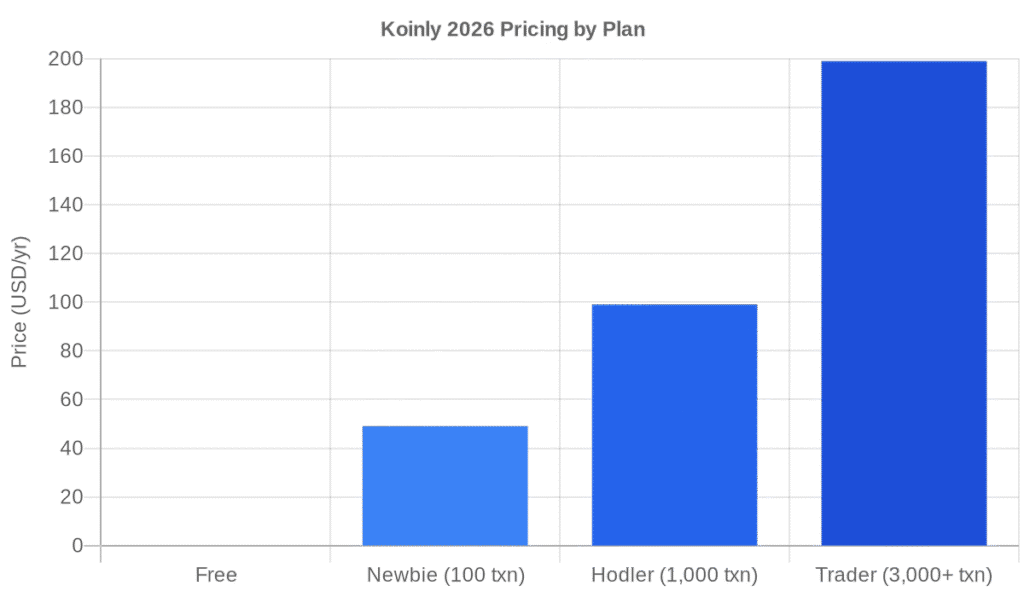
Pricing runs $49/yr for 100 transactions, $99/yr for up to 1,000, and $199/yr for up to 3,000. The free plan covers portfolio tracking and transaction imports but won’t generate a tax report. It’s useful as a sanity check before you commit to paying.
DeFi support is solid. Koinly automatically imports from major L1 blockchains, handles staking and liquidity pool activity, and filters out spam tokens (a bigger annoyance than it sounds if you’ve ever opened a wallet full of airdrop junk). Where it gets trickier is highly complex multi-step DeFi transactions — it handles most, but we’ve seen edge cases where manual classification was needed.
Who it suits: International investors, anyone with a diversified portfolio across both CEX and DeFi, users who want the clearest path to a country-specific report.
Who should look elsewhere: Very high-volume traders (3,000+ transactions get expensive) and anyone needing deep US-accountant integration may find CoinLedger or TokenTax a better fit.
CoinLedger — Best for US Filers
CoinLedger positions itself around error reconciliation — the idea being that other platforms import your data while CoinLedger actively helps you identify missing cost basis, data gaps, and mismatched records before you file. That focus matters more than it might seem; a single missing cost basis on a large transaction can trigger an audit flag.
It integrates directly with TurboTax, H&R Block, and TaxAct, which makes the actual filing step nearly frictionless for US users. Pricing mirrors Koinly: $49 for up to 100 transactions, $99 for up to 1,000, $199 for up to 3,000.
The support reputation is notably strong. Unlike some crypto tax platforms that disappear when you have a problem in February, CoinLedger maintains live support across all plans — not just premium tiers.
Where it falls short: international support is limited. If you’re filing outside the US, you’re not getting a country-specific report; you’ll be working from a generic gains summary. For the UK, Australia, or any European jurisdiction with specific reporting formats, Koinly does it better.
Who it suits: US-based active traders who need clean TurboTax integration and want an extra layer of error checking.
Who should look elsewhere: Non-US users, and anyone with heavy DeFi activity (CoinLedger handles it, but Summ specializes in it).
CoinTracker — Best for Portfolio Tracking
CoinTracker’s free plan is genuinely useful in a way most competitors aren’t. You get a full portfolio dashboard — real-time balances across exchanges and wallets, unrealized gains, performance tracking — at no cost. For the investor who wants visibility without commitment to a tax report, that’s a reasonable starting point.
The paid plans start at $59/yr for 100 transactions, $199/yr for up to 1,000 (Prime), and $599/yr for up to 10,000 (Ultra). One meaningful difference from Koinly: CoinTracker’s paid plans cover all tax years, while Koinly prices per tax year. If you have a backlog to clean up, that changes the math considerably.
Having said that, the integration gap is real. CoinTracker supports around 170 auto-sync integrations; the remaining 370+ require manual CSV uploads, sometimes reformatted into CoinTracker’s own template. For anyone with multiple DeFi positions across less mainstream protocols, that’s a lot of manual work. Multi-step DeFi transactions — a swap, a liquidity deposit, and a reward claim all in one on-chain action — can get partially captured or miscategorized.
International coverage is another weak point. Outside the US and Canada, you’re largely working with basic CSV exports rather than country-specific reports.
Who it suits: US-based investors who primarily use centralized exchanges and want strong portfolio tracking built in.
Who should look elsewhere: DeFi-heavy users and anyone outside North America.
Summ (Formerly CryptoTaxCalculator) — Best for DeFi

Summ rebranded from CryptoTaxCalculator in late 2024, but the product focus didn’t change: it’s the most DeFi-native option in this comparison. It connects to 150+ exchanges, 500+ wallets, and over 2,300 DeFi protocols — including the kind of obscure L2 and cross-chain activity that other platforms throw into an “unidentified” bucket.
The AI-driven auto-categorization handles gas fees, failed transactions, NFT minting, and complex sequences where a single on-chain interaction triggers multiple taxable events. That’s genuinely harder than it sounds. Most crypto tax platforms treat on-chain activity as discrete transactions; Summ understands transaction context.
Pricing: $49, $99, $249, and $499, scaling with transaction volume. No free plan worth mentioning.
The user experience is more technical than Koinly or CoinLedger — Summ assumes you know what a liquidity pool is and don’t need it explained. That’s fine for its target audience. Less fine if you’re a casual investor who happened to use a DeFi protocol once and now needs to report it.
Who it suits: DeFi-native users, yield farmers, anyone with significant on-chain activity across multiple protocols and chains.
Who should look elsewhere: Casual investors and pure CEX users — you’re paying for depth you won’t use.
ZenLedger — Best Budget Option for US Users
ZenLedger has been around since 2017 and positions itself on simplicity and CPA integration. It connects to 400+ exchanges and wallets, handles staking and DeFi, and integrates with TurboTax and H&R Block. The Silver plan at $49/yr covers up to 100 transactions — reasonable if your activity is light. Gold covers up to 5,000 transactions for $199/yr, which is notably better value per transaction than most competitors at that tier.
The CPA access feature is legitimately useful. ZenLedger lets you share a read-only view with your accountant, which saves back-and-forth on data questions. If you use a human tax professional alongside the software, that workflow is smoother here than elsewhere.
International coverage is US-focused. Not much to recommend it for non-US users over Koinly or Blockpit.
Who it suits: US investors with straightforward portfolios who want TurboTax/accountant integration at a fair price.
Who should look elsewhere: DeFi power users (Summ handles complexity better), international users (Koinly).
Is Free Crypto Tax Software Actually Worth It?
Technically yes — to a point. Koinly, CoinLedger, and CoinTracker all offer free tiers that let you import your data, check your portfolio, and see estimated gains before committing. That’s useful for understanding your tax exposure without spending anything.
But the free tiers stop short of giving you anything you can actually file. You don’t get downloadable tax reports, IRS forms, or TurboTax exports on any free plan. If your volume is genuinely low — say, under 25 transactions in a tax year — some platforms will generate a basic report for free, but check the current terms before assuming.
For a truly free crypto tax calculator option, Bitcoin.Tax (bitcoin.tax) offers a limited free tier that includes up to 20 transactions per year. It’s basic, but it covers the very casual investor case.
Long story short? If you’ve had any meaningful crypto activity, budget for a paid plan. At $49/yr, most options cost less than your accountant’s hourly rate and save considerably more time.
How to Choose a Crypto Tax Calculator
Start with where your activity actually lives:
- Primarily on centralized exchanges (Coinbase, Binance, Kraken)? → CoinLedger or CoinTracker. Strong CEX integration, US-friendly.
- Heavy DeFi, yield farming, multiple chains? → Summ. The protocol coverage is unmatched.
- Non-US filer? → Koinly. It’s built for international use, not just added as an afterthought.
- High transaction volume? → Compare per-transaction cost at your volume tier. ZenLedger’s Gold plan (5,000 transactions at $199/yr) beats Koinly and CoinLedger on that metric.
- Using an accountant? → ZenLedger’s CPA sharing feature makes that workflow cleanest.
One underrated consideration: the back-year problem. If you’ve been in crypto since 2020 and never properly tracked, you’re dealing with multiple years of history. CoinTracker and ZenLedger price their plans to cover all tax years (not per-year), which matters if you’re catching up.
FAQ
What is the best free crypto tax software?
None of the top platforms offer completely free tax reports. Koinly, CoinLedger, and CoinTracker all have free tiers for portfolio tracking and viewing gains, but tax report downloads require a paid plan. Bitcoin.Tax offers free filing for up to 20 transactions per year.
Is Koinly the best crypto tax software?
For most users, yes — particularly anyone outside the US or with a mix of CEX and DeFi activity. It supports 1,000+ integrations, 20+ countries, and produces country-specific reports. For US-only filers who prioritize TurboTax integration, CoinLedger is a competitive alternative.
Does crypto tax software work with Form 1099-DA?
Yes. Since Form 1099-DA only reports gross proceeds (not cost basis) for the 2025 tax year, crypto tax software helps you reconcile the form against your actual cost basis records. Without it, you risk overstating your taxable gains.
What is the difference between Koinly and CoinTracker?
Koinly has broader international coverage (20+ countries vs. CoinTracker’s US/Canada focus) and stronger DeFi integration (1,000+ platforms vs. ~170 auto-sync on CoinTracker). CoinTracker’s free portfolio tracker is more polished, and its paid plans cover all tax years — not per-year. For most international users, Koinly wins. For US-based CEX users who want solid portfolio tracking, CoinTracker is reasonable.
Can I use crypto tax software if I only have a few transactions?
Yes, and at low volumes the free tiers may be sufficient to at least understand your exposure. For under 25 transactions, check whether your chosen platform offers a free report tier — some do. At under 100 transactions, the $49 entry tier on most platforms is inexpensive relative to the time it saves.
Do I still need crypto tax software if I got a 1099-DA?
Most likely. The 2026 Form 1099-DA reports gross proceeds only, not cost basis — which means the figure it shows could be far higher than your actual taxable gain. If you moved crypto between wallets, used DeFi, or have multi-year cost basis to track, the form covers only part of your picture. Crypto tax software fills the gaps.

Our Review Methodology
We evaluate each post based on thorough research, credibility of sources, accuracy of information, and relevance to our readers. Our editorial team follows strict guidelines to ensure all content meets high standards of quality.
Disclaimer
The content in this article is provided for informational purposes only and does not constitute financial, investment, or professional advice. Always do your own research before making any decisions.


