Most people have signed a contract at some point. You agree to terms, the other party agrees to terms, and then — in theory — both sides do what they promised. The problem has always been the “in theory” part. Contracts require enforcement. Enforcement requires people. People cost money, make mistakes, and occasionally just don’t show up.
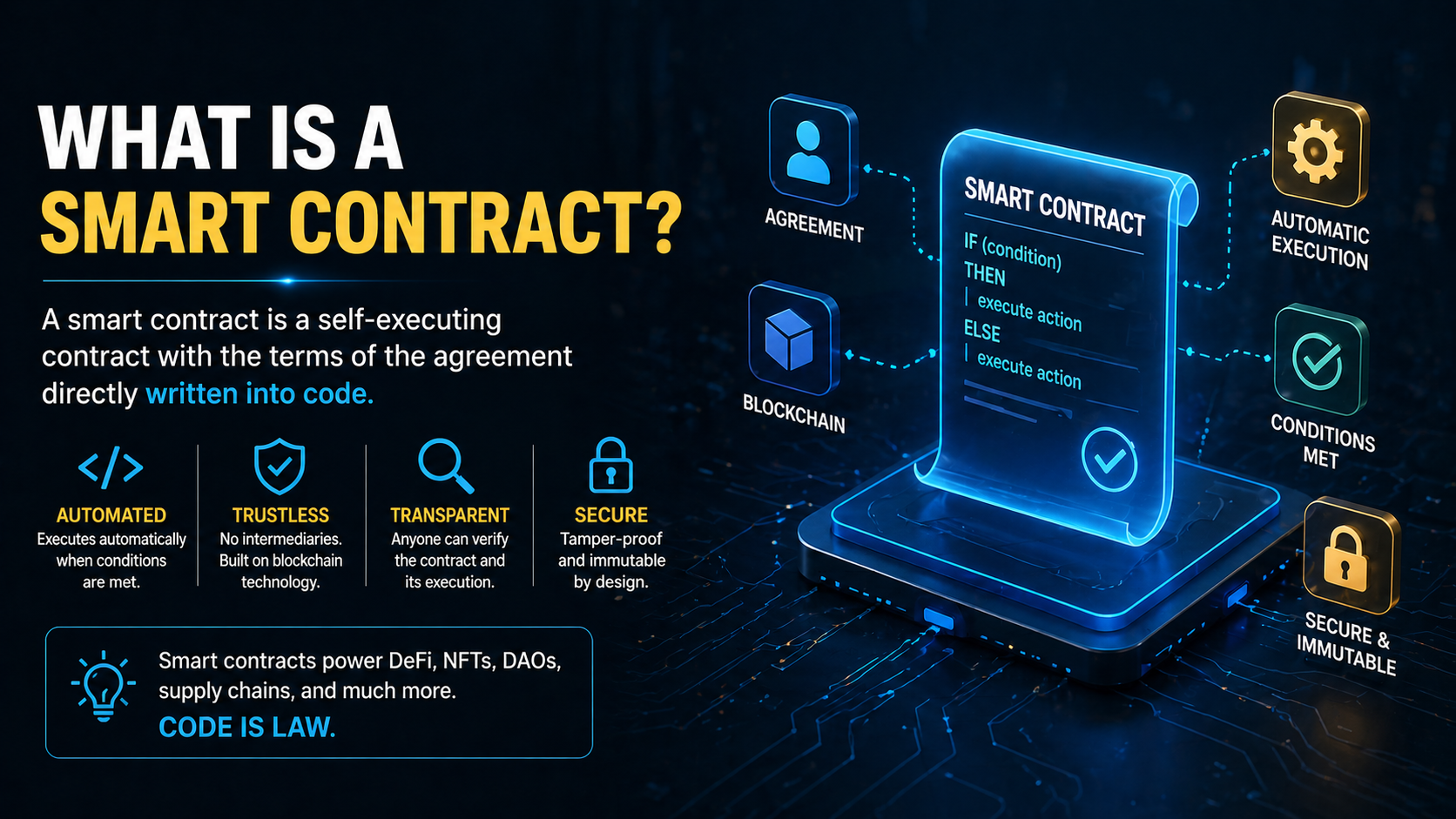
Smart contracts cut the middleman out entirely. They’re programs that live on a blockchain and execute automatically when predefined conditions are met — no lawyer needed, no bank to authorize the transfer, no waiting three business days for a wire to clear. When the conditions are met, the contract runs. That’s it.
That’s a simple idea with big implications, especially for anyone trading crypto or exploring decentralized finance.
A smart contract is self-executing code deployed on a blockchain that automatically enforces the terms of an agreement. Ethereum hosts the largest ecosystem of smart contracts, with over 44 million deployed since the network launched in 2015 (CryptoPotato, 2024). They power DeFi lending, NFT trading, decentralized exchanges, and more — with no human intermediary required.
Smart Contracts Defined: More Than Just Code
Most software runs on servers owned by companies. A smart contract runs on the blockchain itself — deployed to a public address, triggered by conditions, executed automatically. Put in the right input — your payment, your signature, your data — and the contract runs. No attendant, no negotiation, no trust required beyond trusting the code.
Nick Szabo coined the term in 1994 and compared smart contracts to vending machines in his 1996 paper: mechanical, automatic, governed entirely by inputs and predetermined logic. What the code says happens. What it doesn’t say doesn’t. That framing still holds 30 years later.
The “smart” part doesn’t mean the contract is intelligent. It means it’s programmable and automatic. The “contract” part is somewhat misleading too, at least legally (more on that later). The actual function is simpler: encode agreement terms in code, deploy to a blockchain, and it runs exactly as written — without anyone’s permission, and without anyone being able to stop it.
We tested this firsthand while reviewing a decentralized exchange last year. You approve a transaction, set your parameters, and the protocol executes at exactly the price range you specified. No slippage surprises from a broker holding your order, no counterparty risk from a platform that could freeze withdrawals. The smart contract did what it said it would do, at the moment the conditions matched. That kind of predictability is genuinely rare in markets.
The code is typically public. Anyone can inspect what a contract will do before interacting with it — which is why DeFi attracted serious capital from institutional players who wouldn’t touch “trust us” platforms. Verify the code; trust becomes optional.
Smart contracts live on decentralized blockchains, which makes them tamper-proof and censorship-resistant. Once deployed, nobody can modify or stop them — not the developer, not a government, not even the original author. That’s the source of both the power and the risk.
Who Invented Smart Contracts?
Smart contracts are older than Bitcoin. Nick Szabo conceptualized them in 1994 (and formalized the idea in a 1996 paper titled “Smart Contracts: Building Blocks for Digital Markets”), more than a decade before there was any blockchain capable of running them. His original framing compared them to vending machines — mechanical and automatic, governed entirely by inputs and predetermined logic.
The concept stayed theoretical for years. No network existed that could run trustless, distributed code. Bitcoin changed the foundation when it launched in 2009 and demonstrated trustless value transfer on a decentralized ledger — but Bitcoin’s scripting language was intentionally limited. Multi-signature transactions were possible (requiring multiple keys to authorize a transfer), but not much else.
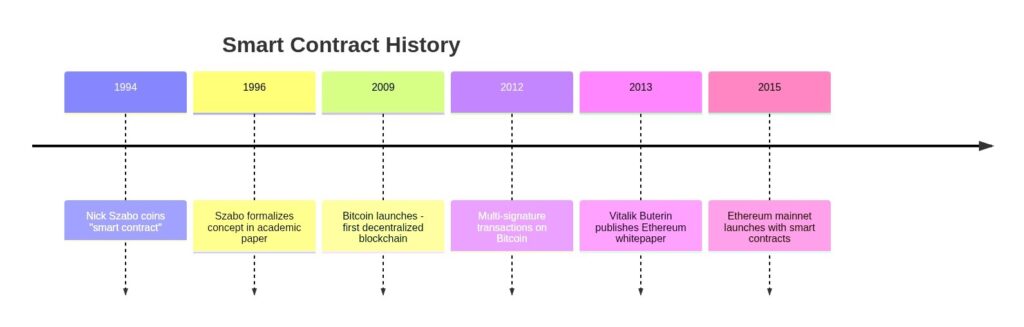
Ethereum changed what was possible. A whitepaper circulated in late 2013 — written by a 19-year-old programmer named Vitalik Buterin — proposed a blockchain with a Turing-complete programming language that could execute arbitrary smart contracts. The Ethereum mainnet launched on July 30, 2015, and the ecosystem it created is still expanding a decade later. For the first time, developers could deploy programs to a decentralized network and know they’d run exactly as written, enforced by thousands of nodes simultaneously.
The timeline matters because smart contracts aren’t startup hype. More than 30 years of theoretical development, over a decade of live blockchain execution. The question isn’t whether they work — it’s which applications are worth building on them.
How Does a Smart Contract Work?
The mechanics are straightforward, even if the underlying engineering isn’t.
A smart contract operates on simple if/then logic: if condition A is met, action B occurs. That logic executes automatically, verifiably, and permanently on a distributed ledger, with every node in the network independently confirming the result.
DeFi lending is the clearest illustration. You deposit 2 ETH as collateral, and the protocol releases $2,000 USDC to your wallet. The smart contract holds your collateral in escrow. If the value of your ETH drops below a liquidation threshold — say, $3,000 — the contract automatically sells your collateral to repay the loan. No phone calls, no credit officer, no court order. The code decides. Aave’s entire lending market, which has processed billions in loans, works exactly this way.

Writing a smart contract starts with code — most commonly Solidity for Ethereum, Rust for Solana, Plutus for Cardano. The developer writes the logic, tests it, and submits it to the blockchain. At that point the contract gets an address (just like a wallet address) and can receive and send value.
Each interaction with a smart contract on Ethereum costs “gas” — transaction fees paid in ETH to compensate the validators running the network. Gas prices fluctuate with network congestion, which is a known frustration. During the DeFi boom of 2021, gas fees on Ethereum sometimes hit $100 or more per transaction, making small-value interactions economically irrational.
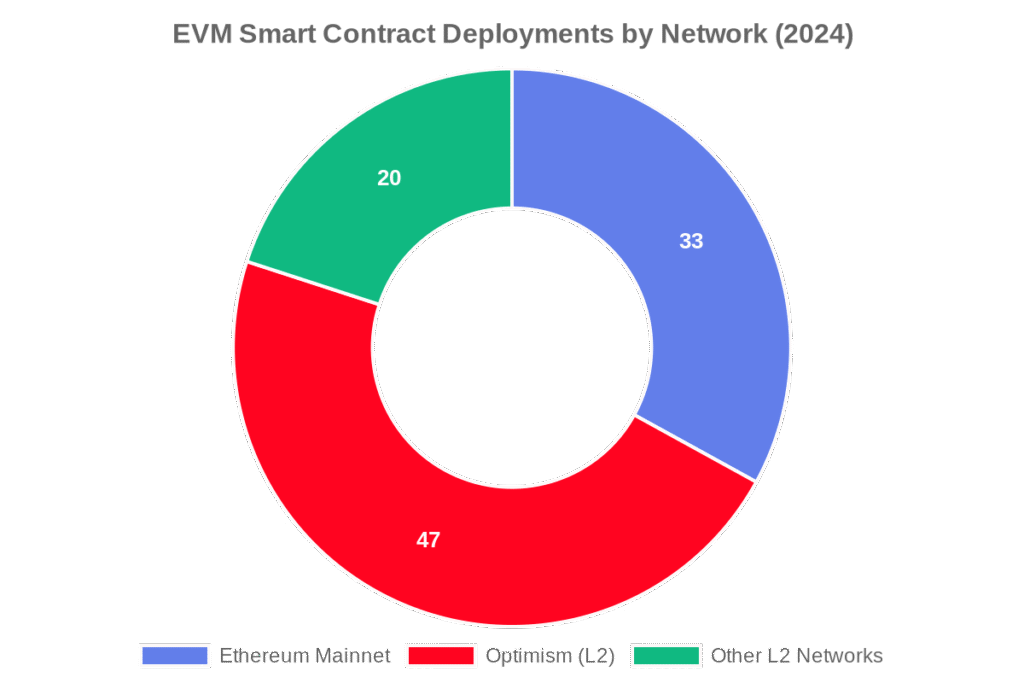
That’s part of why Layer-2 networks (Optimism, Arbitrum, Base) exist. They run the same smart contract logic at a fraction of the cost by batching transactions off-chain and settling them on Ethereum’s mainnet. In 2024, L2s accounted for the majority of all EVM-compatible smart contract deployments worldwide.
What Are Smart Contract Examples?
Smart contracts run the bulk of the crypto ecosystem. These aren’t theoretical applications — they’re handling real money, right now.
Decentralized exchanges (DEXs). Uniswap, Curve, and dYdX execute billions in daily trading volume through smart contracts. There’s no order book managed by a company, no platform holding your funds. A pool of liquidity locked in a smart contract handles swaps when you submit a transaction. Uniswap alone has processed over $2 trillion in cumulative trading volume as of 2024 (DeFiLlama, 2024) — entirely through on-chain smart contract logic.
DeFi lending and borrowing. Protocols like Aave and Compound let you deposit crypto as collateral and borrow against it. The interest rate, collateral ratio, and liquidation triggers are all defined in the smart contract — not decided by a loan officer. For traders using copy trading strategies on Tradelize, some of these DeFi primitives feed directly into automated portfolio management.
NFTs. The minting, transfer, and royalty rules for non-fungible tokens are encoded in smart contracts (typically ERC-721 or ERC-1155 on Ethereum). When an NFT sells on a marketplace, the smart contract automatically routes the creator’s royalty percentage to their wallet — something the traditional art market has never managed to enforce reliably.
Insurance. Parametric insurance protocols like Arbol use smart contracts to pay out automatically when measurable conditions are met — a weather station records drought conditions, the contract pays the farmer. No claims adjuster, no dispute process, no “we’ll need to review your documentation” emails.
Supply chain. IBM Food Trust and similar systems use smart contracts to verify that a shipment has cleared customs, passed quality checks, or changed hands — then trigger payment automatically when conditions are confirmed on-chain.
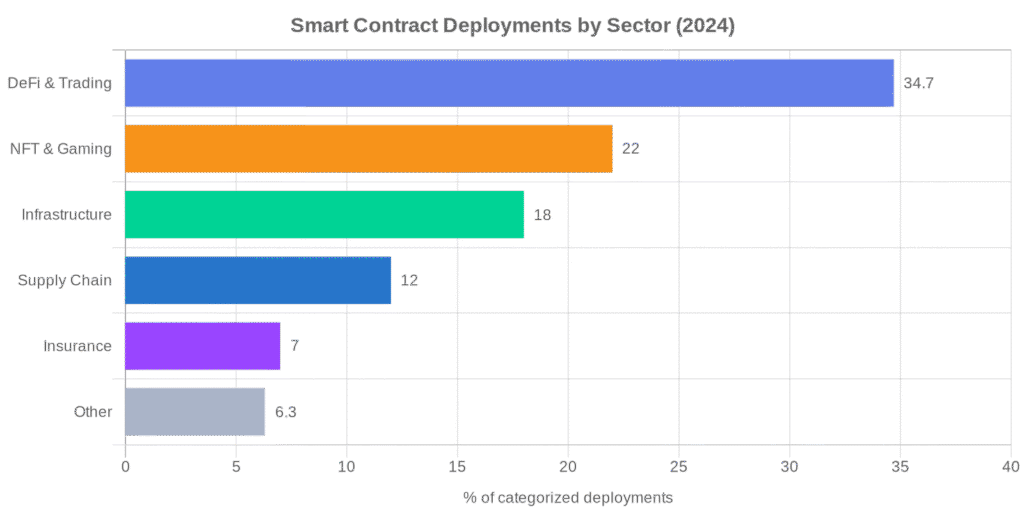
For crypto traders specifically, smart contracts underpin every decentralized trading protocol you interact with. If you’ve ever swapped tokens on a DEX, borrowed against your portfolio, or participated in yield farming, you’ve used smart contracts — whether you realized it or not.
Ethereum Smart Contracts Explained
Ethereum dominates the smart contract ecosystem, and the numbers are unambiguous. Over 44 million contracts have been deployed to Ethereum since the network’s genesis in 2015 (CryptoPotato Research, 2024). The total across all EVM-compatible chains — including Layer-2s — approached 70 million by late 2024, according to blockchain security firm Zellic.
All of this runs through the Ethereum Virtual Machine (EVM): a sandboxed runtime that executes smart contract code in isolation, simultaneously, on every node in the network. Every node verifies every outcome, and results have to match before the blockchain state updates. That’s what makes it trustless.

Most Ethereum developers write in Solidity — built specifically for the EVM, syntactically similar to JavaScript. Alternatives include Vyper (simpler and more auditor-friendly) and Yul (for low-level optimization). Language choice affects security properties, readability, and how many qualified auditors can review the code before deployment.
What Ethereum brought that Bitcoin couldn’t was Turing-completeness — the ability to express any computable function in contract logic. Bitcoin can verify “has this address signed this transaction?” Ethereum can verify “has this pool maintained a 150% collateralization ratio, triggered a liquidation, sold the collateral at market price, and distributed the proceeds to the correct addresses?” All in a single atomic transaction.
In 2024, Layer-2 networks accounted for over two-thirds of all EVM smart contract deployments, with Optimism alone responsible for roughly 70% of that Layer-2 activity (Blockworks, 2024). The practical implication: the smart contract ecosystem’s center of gravity has shifted to L2s without the underlying security model changing. If you’re comparing platforms on Tradelize’s crypto exchange reviews, checking whether an exchange supports L2 networks for smart contract interactions is increasingly a meaningful differentiator.
What Are the Benefits of Smart Contracts?
The case for smart contracts isn’t hypothetical — it’s operational.
Automation without trust. Traditional agreements rely on counterparties to behave honestly, and legal systems to punish them when they don’t. Smart contracts make honest behavior the only possible behavior. The code runs as written, and no party can selectively decide not to honor the terms.
Speed. Bank wire transfers take 2–3 business days. Smart contracts settle in seconds to minutes, depending on network congestion and whether you’re on mainnet or a Layer-2. For cross-border payments and DeFi operations, that’s not just faster — it’s a fundamentally different architecture.
Cost. Remove the intermediaries — banks, lawyers, escrow agents, clearinghouses — and you remove their fees. In DeFi, you pay gas costs and protocol fees, typically 0.01%–0.30% per transaction. Traditional financial intermediaries charge 1%–3% for equivalent services. At volume, that gap is real money.
Smart contract code is public and auditable. Anyone can verify what the contract will do before interacting with it. A bank’s terms of service can change without notice, and no user can confirm the bank is actually honoring them — that’s not a concern with audited, on-chain code. Worth keeping in mind if you’ve ever wondered why institutional players moved into DeFi as quickly as they did.
Precision. Same inputs, same outputs, every time. There’s no discretion for the contract to “interpret” terms favorably to one party. Smart contracts execute deterministically.
Can Smart Contracts Be Hacked? Risks You Should Know
Smart contracts are only as good as the code that writes them. No trust layer, no appeals process, no “wait, that’s not what we meant.” The code executes.
The most famous example: in June 2016, a hacker exploited a reentrancy vulnerability in The DAO — a smart contract managing a $150 million investment fund on Ethereum — and drained approximately $60 million in ETH before the community could respond. The fix required a hard fork of the Ethereum blockchain itself (which created Ethereum Classic as a byproduct of the controversy), because the contract had executed correctly according to its code. The code was the vulnerability.
This is the core tension. The property that makes smart contracts trustworthy — immutability, automatic execution — is also what makes a bug catastrophic. You can’t pause a smart contract mid-execution to fix a problem. Once deployed, the logic runs as written.
Common vulnerability classes include:
- Reentrancy attacks — The DAO’s downfall. A malicious contract calls back into the target before the first execution completes, draining funds in a loop.
- Integer overflow/underflow — Mathematical operations that wrap around numerical limits (largely mitigated in Solidity 0.8+, but still present in older deployed contracts)
- Access control failures — Incorrect permissions allow unauthorized parties to call restricted functions
- Oracle manipulation — Smart contracts that rely on external price feeds can be exploited by flash loan attacks that temporarily distort market prices
The industry response has been substantial: professional auditing firms (Trail of Bits, OpenZeppelin, Certik) review contracts before deployment. Major protocols run formal verification, bug bounty programs, and phased rollouts with limited value at risk. But no audit guarantees safety — it reduces risk, it doesn’t eliminate it.
The practical implication for traders: check whether the DeFi protocols you interact with have been audited, how recently, and by whom. This is publicly verifiable. An unaudited protocol is a meaningful, quantifiable risk factor — not just a theoretical concern.
Are Smart Contracts Legally Binding?
Genuinely complicated, and the honest answer is: it depends — usually not in the traditional sense.
In most jurisdictions, a legally enforceable contract requires offer, acceptance, consideration, and identifiable parties who can be held liable. Most smart contracts involve pseudonymous or anonymous participants. You can’t sue a blockchain address.
Some legal frameworks are beginning to catch up, though. Arizona passed legislation in 2017 recognizing smart contracts as legally valid and enforceable, provided they satisfy existing requirements for contract formation. The UK Law Commission issued guidance in 2021 affirming that smart contracts can be valid legal contracts under English law. The European Union’s MiCA regulation, which came into effect in stages from 2024, addresses crypto asset frameworks — though smart contract legality specifically remains under development in the EU context.
The practical reality: if a smart contract executes as coded and one party is unhappy with the outcome, legal recourse is limited. Courts are still working out how to handle disputes where the “contract” is a program that cannot be modified and has already run. In DeFi, your protection is the audited code — not the legal system. Worth knowing that going in.
The Bottom Line on Smart Contracts
Smart contracts are self-executing blockchain programs that automate agreements without intermediaries, running exactly as coded on a decentralized network. They’re not a future technology — they process billions of dollars in daily DeFi volume right now, across Ethereum, its Layer-2 networks, and competing chains. Understanding how they work, where they run (Ethereum’s 44+ million deployed contracts being the benchmark), and where they can fail (code bugs are real and have cost hundreds of millions) is foundational knowledge for anyone operating in crypto markets today. If you’re evaluating exchanges, wallets, or trading protocols, see our full crypto platform reviews on Tradelize — and check whether the platforms you’re considering interact with audited smart contracts.
Frequently Asked Questions About Smart Contracts
What is the difference between a smart contract and a regular contract?
A regular contract is a legal agreement enforced by courts and intermediaries. A smart contract is code deployed on a blockchain that enforces itself automatically when conditions are met — no lawyers, no courts, no waiting. The tradeoff: smart contracts are precise but inflexible. A regular contract can be interpreted by a judge; a smart contract executes literally, regardless of intent.
What programming language are smart contracts written in?
Ethereum smart contracts are mostly written in Solidity — it’s syntactically similar to JavaScript, built specifically for the EVM. Alternatives exist: Vyper (simpler, more auditor-friendly) and Rust (used on Solana). Language choice affects security properties, code readability, and how many qualified auditors can review the contract before deployment.
What is an Ethereum smart contract?
An Ethereum smart contract is code deployed to the Ethereum blockchain, with its own address, able to hold ETH and tokens, and executing automatically when called by another address or transaction. Ethereum was the first major blockchain with Turing-complete smart contract support, launching on July 30, 2015. It now hosts the largest smart contract ecosystem globally, with over 44 million contracts deployed since genesis.
Can a smart contract be changed after deployment?
Standard smart contracts are immutable — once deployed, the code cannot be altered. Some contracts use upgradeable proxy patterns (a workaround that points users to a new contract implementation), but these introduce their own trust assumptions: whoever controls the upgrade mechanism can change the behavior. Immutability is both the security guarantee and the operational constraint. Most mature DeFi protocols that use upgradeable contracts have time-locked governance mechanisms to limit this risk.
What happens if a smart contract has a bug?
The damage is typically irreversible — the contract executed as written, even if that wasn’t the developer’s intent. The Ethereum hard fork following The DAO hack in 2016 (where ~$60 million in ETH was exploited) is the most dramatic example of the community attempting to reverse an exploit — and it remains deeply controversial. Today, prevention through professional audits, formal verification, and staged rollouts with limited initial value at risk is the only reliable defense.

Our Review Methodology
We evaluate each post based on thorough research, credibility of sources, accuracy of information, and relevance to our readers. Our editorial team follows strict guidelines to ensure all content meets high standards of quality.
Disclaimer
The content in this article is provided for informational purposes only and does not constitute financial, investment, or professional advice. Always do your own research before making any decisions.