
Most introductions get Ethereum wrong from the start: it’s not really a cryptocurrency. It’s a programmable blockchain — one that uses a currency (ETH) to compensate validators for computation. The cryptocurrency aspect is almost incidental. As of April 2026, this chain holds a market cap of approximately $256.5 billion (CoinGecko, April 2026), settles 1.74 million transactions daily (ConsenSys, August 2025), and underpins virtually every major DeFi protocol on the planet. Understanding it means understanding what makes it different from every other crypto project. It hinges on the programmable layer.
Ethereum is a blockchain network where anyone can build and run applications using smart contracts. Its native currency is Ether (ETH), which powers every transaction. Ethereum handles over 1.74M daily transactions and dominates 56.5% of all DeFi activity globally. Programmable money, built on the platform that runs it.
What Is Ethereum, Exactly?
In 2013, a 19-year-old programmer had one question: what if Bitcoin could run programs? He wrote a whitepaper. The Ethereum project took shape from that idea, and the network launched July 30, 2015. The core premise hasn’t changed. Where Bitcoin is a ledger tracking who owns what, Ethereum is a global computer anyone can run code on. “Ethereum is the rebellion against” centralized platforms that lock users in with subscriptions and data silos, Buterin wrote in January 2026 (CoinDesk, January 2026).
Thousands of computers (nodes) spread across the world run it, with no single company or government controlling any of them. When you send ETH, deploy a smart contract, or interact with a DeFi app, that action gets verified by a global network of validators and recorded permanently on the Ethereum blockchain.
“The world computer” is the common shorthand. A bit dramatic, but not wrong. Anyone can write and deploy code on Ethereum without prior approval from any centralized authority — that permissionless openness is what made the entire DeFi ecosystem possible.

How Does Ethereum Work?
Every ~12 seconds, a new batch of transactions gets bundled into a “block” and added to the Ethereum chain (Ethereum Foundation, 2026). That’s the rhythm of the network, with thousands of nodes worldwide maintaining a shared database simultaneously. Bitcoin takes 10 minutes per block. At ~12 seconds, Ethereum moves considerably faster — which is why the transaction throughput differs so dramatically.
The chain currently has around 6.1 million nodes globally (via Etherscan, as cited by Kraken). These nodes store data AND run the Ethereum Virtual Machine (EVM), a sandboxed interpreter that executes on-chain contract code. Solidity is the language most developers use to write those contracts, though Vyper is also common.
So what keeps everyone honest? Since 2022, Ethereum has operated on Proof of Stake (PoS), introduced with an upgrade known as The Merge (September 2022). Instead of miners burning electricity to validate blocks (Bitcoin’s approach), Ethereum validators lock up ETH as collateral. Running a full validator node requires at minimum 32 ETH. If they try to cheat, they lose their stake. As of August 2025, 35.7 million ETH (roughly 29.8% of the total supply) is staked this way (ConsenSys, August 2025).

Gas Fees
There’s one thing that trips up nearly every new Ethereum user: gas. Every transaction or contract execution costs gas, a fee paid in ETH to compensate validators for computation. The amount varies depending on network demand. During the 2021 NFT boom, gas charges could hit $100+ for a single swap. Post-Merge and with Layer 2 solutions now mature, fees on networks like Arbitrum and Base can be fractions of a cent.
The crypto exchange fees guide on Tradelize covers this in more detail, including how exchange fees compare to on-chain gas.
What Is Ether (ETH)?
You can’t use Ethereum without ETH. That’s the design, not a technicality. Every transaction, every smart contract execution, every NFT mint requires ETH to pay gas fees. Ether is the fuel that runs the network — and yes, you can trade it too.
As of April 2026, ETH trades at around $2,125, with approximately 121.6 million coins in circulation (CoinGecko, April 2026). That valuation of ~$256.5 billion makes it the second-largest cryptocurrency in the world, trailing only Bitcoin (which it has never surpassed). Unlike Bitcoin’s hard cap of 21 million coins, Ethereum has no fixed maximum supply, though post-Merge the issuance rate has slowed considerably and some periods have seen the supply actually decrease as transaction burns exceed new issuance.
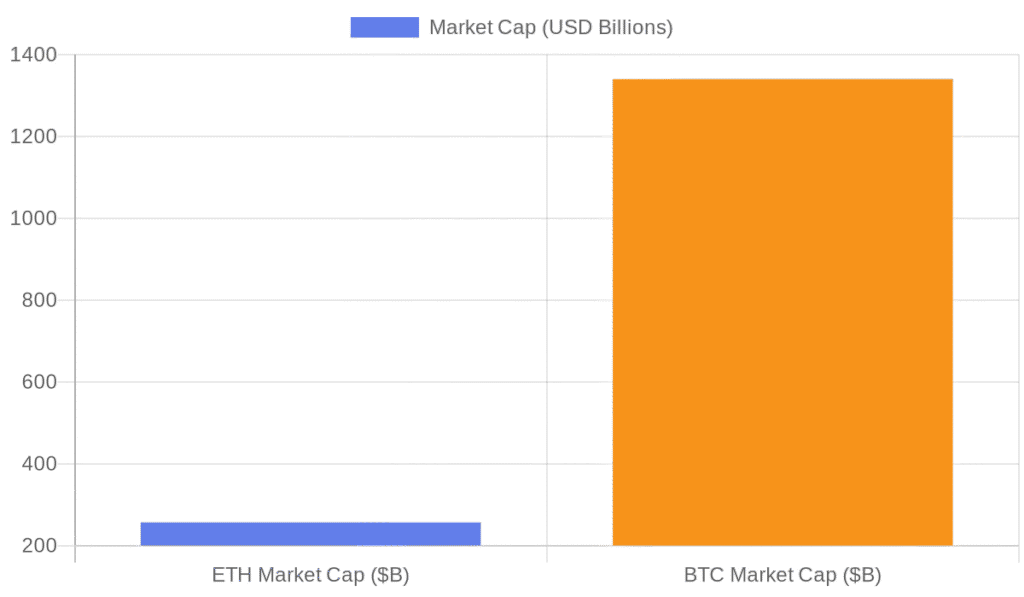
This issuance dynamic distinguishes ETH from purely deflationary assets. During periods of heavy on-chain activity, transaction fee burns can outpace validator rewards, temporarily shrinking the circulating supply. In practice, ETH has flipped deflationary at multiple points since The Merge.
Why does ETH have value? A few reasons. It’s needed to use the network, which creates real demand. Staking ties up supply, reducing selling pressure. And Ethereum’s role as the foundation for the DeFi and NFT ecosystems means its utility is tied to the entire value of those markets.
What Are Smart Contracts?
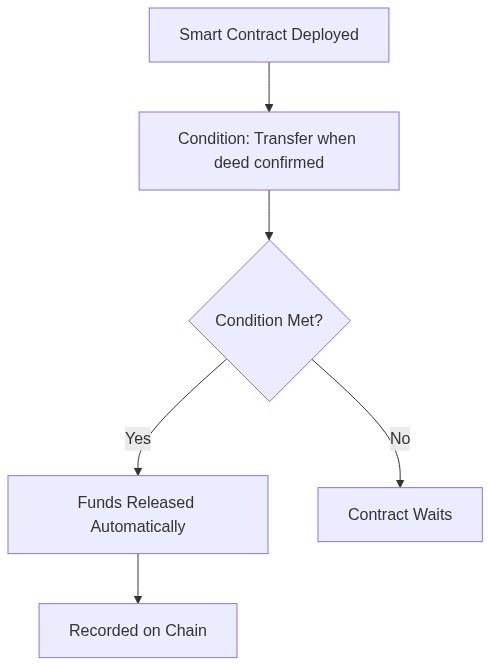
Picture an escrow service — except the escrow agent is a piece of code that no one can bribe, delay, or overrule. A smart contract is code stored on the Ethereum blockchain that runs automatically when pre-set conditions are met. No middleman. No bank. No notary.
Imagine buying a house without a lawyer holding the funds. With a smart contract, you code the logic once: release payment when deed transfer confirms on-chain. The contract handles it automatically. Neither party can stop it, freeze it, or walk away once conditions trigger.
That sounds niche until you consider how much of traditional finance runs on “a third party holds funds and releases them based on conditions.” That’s every loan, every insurance claim, every trade settlement. Smart contracts replace the intermediary with code.
The Ethereum development community writes these contracts primarily in Solidity (a language that resembles JavaScript), which gets compiled to EVM bytecode. Once deployed, the contract lives at a specific Ethereum address permanently. You can’t unpublish it.
How Is Ethereum Different from Bitcoin?
Bitcoin and Ethereum get lumped together constantly, treated as a single monolithic category. They’re genuinely built for different things — conflating them is like comparing email to a spreadsheet because both run on computers.
| Feature | Ethereum (ETH) | Bitcoin (BTC) |
|---|---|---|
| Primary purpose | Programmable platform for dApps, DeFi, NFTs | Store of value / digital currency |
| Consensus | Proof of Stake (since Sep 2022) | Proof of Work (mining) |
| Block time | ~12 seconds | ~10 minutes |
| Supply | ~121.6M, no hard cap | 21M hard cap |
| Smart contracts | Yes (native, Turing-complete) | Limited (no Turing-complete scripting) |
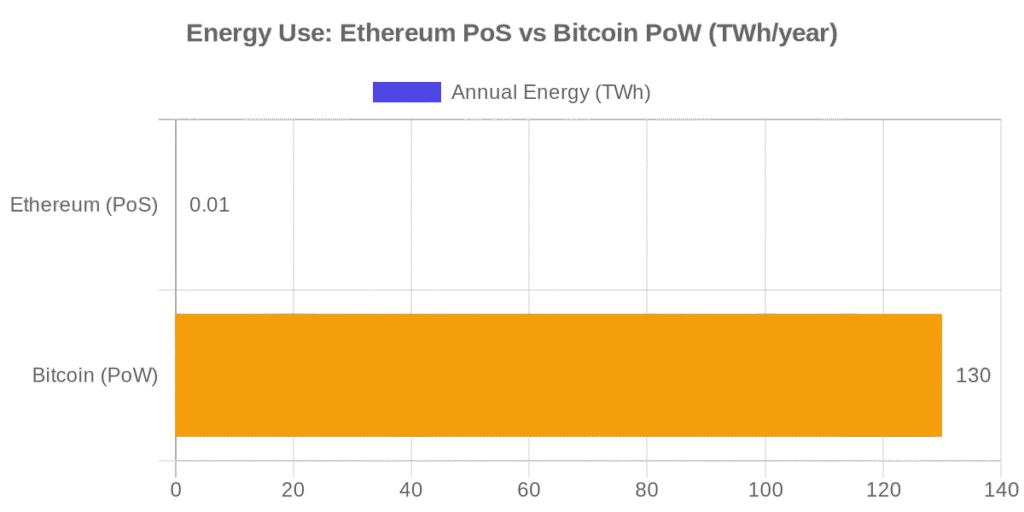
| Energy use | 0.01 TWh/year (post-Merge) | ~130+ TWh/year |
| Programmability | High — full dApp ecosystem | Low — primarily monetary transactions |
The energy contrast is striking. Ethereum’s switch to Proof of Stake made it 99.988% more energy efficient compared to its previous Proof of Work model (Ethereum Foundation, 2026). Bitcoin mining burns roughly as much electricity as a mid-sized country.
For use case: if you want a secure, scarce digital asset, Bitcoin is purpose-built for that. If you want a platform to build financial applications, issue tokens, or run decentralized services, that’s Ethereum’s domain.
What Can You Use Ethereum For?
The short answer: more than most people realize.
Decentralized Finance (DeFi) is the biggest one. Ethereum accounts for 56.5% of total DeFi TVL (Total Value Locked) across all blockchains as of October 2025 (Statista, Oct 2025). The ecosystem-wide DeFi TVL hit $166 billion in August 2025 (ConsenSys), and Ethereum’s share of that is roughly $93 billion. Protocols like Aave (lending), Uniswap (trading), and Lido (staking) all run on Ethereum.
NFTs are Ethereum’s most culturally visible use case (for better and worse). The network powers around 62% of all NFT contracts globally (CoinLaw, 2025), and the Ethereum NFT sector generated $5.8 billion in trading volume in Q1 2025 alone (CoinLaw, 2025).
Stablecoins. USDC and DAI, both backed or overcollateralized by crypto assets, run primarily on Ethereum. This is how billions of dollars in dollar-denominated value circulate on-chain without going through a bank.
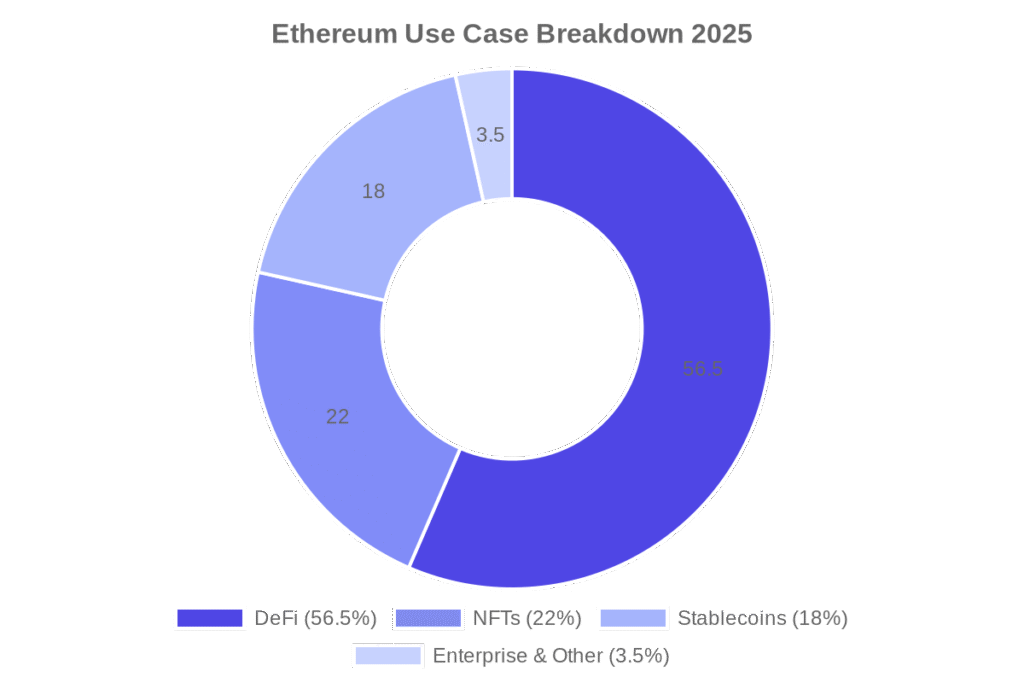
Enterprise applications. Visa and PayPal have both integrated Ethereum-based infrastructure for settlements and digital assets — PayPal’s PYUSD stablecoin runs natively on Ethereum. The United Nations has used Ethereum for aid disbursement in conflict zones. These aren’t experiments anymore. They’re live deployments.
Layer 2 networks. Ethereum’s base layer isn’t cheap for small transactions. That’s by design; it prioritizes security and decentralization. The scaling happens on Layer 2 networks like Arbitrum, Optimism, and Base, which batch transactions and settle them on Ethereum. If you’ve used a DeFi app in 2025-2026, you’ve probably been on an L2 without knowing it.
We remember the first time setting up MetaMask and trying to swap tokens on Uniswap. The interface made sense, the wallet connection was straightforward, and then a $4.50 gas fee popped up on what was supposed to be a $15 trade. Not exactly the frictionless financial system the whitepapers promised. L2s fixed most of this. Running the same swap on Arbitrum now costs maybe $0.03.
How to Get Started With Ethereum
The most common entry points:
Buy ETH on an exchange. Most major centralized exchanges list ETH. You can review crypto exchanges on Tradelize or check the list of top crypto exchanges to compare fees, available features, and regional access. Binance and KuCoin are popular options for ETH specifically.
Set up a wallet. An exchange account lets you hold ETH, but if you want to interact with DeFi, NFTs, or dApps, you’ll need a self-custody wallet. MetaMask is the default for browser-based use. For larger holdings, a hardware wallet adds a layer of security; the hardware wallet guide covers your options. Tradelize’s crypto wallet reviews and best crypto wallets sections rank current options with ratings.
Understand what you’re buying. ETH is a volatile asset. Between November 2024 and early 2025, it ran from lows around $1,300 to near $5,000, then pulled back significantly. It’s not a savings account. The crypto glossary is a useful starting point if the terminology still feels opaque.
For deeper guidance, the full educational guides section covers wallet setup, exchange fees, and more.
The Bottom Line on Ethereum
Ethereum is the programmable backbone of the decentralized internet: a blockchain where smart contracts run DeFi protocols, NFT markets, and stablecoin infrastructure at scale. With a $256.5B market cap, 1.74M daily transactions, and 56.5% dominance in global DeFi TVL, it’s not a speculative experiment; it’s working infrastructure. If you’re looking to understand crypto beyond “number go up,” Ethereum is where the actual application layer lives. Start with the educational guides on Tradelize for a structured path into the ecosystem.
Frequently Asked Questions
Is Ethereum the same as Bitcoin?
No. Bitcoin is primarily a store of value and digital currency with a fixed 21M supply. Ethereum is a programmable blockchain platform whose native currency (ETH) powers automated contracts, DeFi apps, NFTs, and stablecoins. They share blockchain technology but serve fundamentally different purposes.
What is gas on Ethereum?
Gas is the fee paid in ETH to execute transactions or smart contracts on the Ethereum network. It compensates validators for the computational work involved. Gas costs vary with network demand — they spiked during the 2021 NFT boom but are now far lower on Ethereum’s Layer 2 networks like Arbitrum and Base.
Can you stake Ethereum?
Yes. Since The Merge in September 2022, Ethereum runs on Proof of Stake. Running your own validator node requires 32 ETH minimum, but you can stake smaller amounts through liquid staking protocols like Lido or Rocket Pool. As of August 2025, 35.7 million ETH (29.8% of total supply) is staked (ConsenSys, 2025).
What was The Merge?
The Merge was Ethereum’s transition from Proof of Work (mining) to Proof of Stake, completed in September 2022. It reduced Ethereum’s energy consumption by 99.988%, eliminated ETH mining, and introduced validator staking as the consensus mechanism. It’s considered one of the most significant software upgrades in blockchain history.
Is Ethereum a good investment?
That depends entirely on your risk tolerance and timeline. ETH is a volatile asset that dropped nearly 50% between January 2025 and April 2025 before recovering. It has genuine utility as the fuel for a large financial ecosystem, but it’s not a stable asset. Don’t put money in that you’ll need next month.
Disclaimer: This article is for educational purposes only and does not constitute financial or investment advice. Cryptocurrency markets are highly volatile. Always conduct your own research before investing.

Our Review Methodology
We evaluate each post based on thorough research, credibility of sources, accuracy of information, and relevance to our readers. Our editorial team follows strict guidelines to ensure all content meets high standards of quality.
Disclaimer
The content in this article is provided for informational purposes only and does not constitute financial, investment, or professional advice. Always do your own research before making any decisions.